The Story
GuruHits was an online music quiz built by Joe Savelberg in 1997: players heard a five-second clip and named the song or artist. It launched in 2001 after a nearly four-year licensing negotiation with SABAM and ran until 2014.
The idea
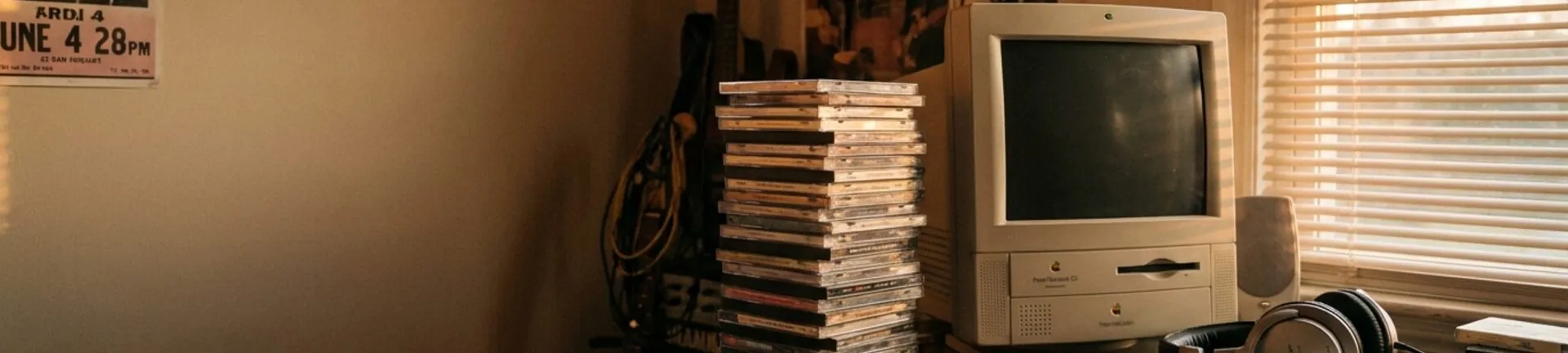
The idea for GuruHits was born in 1997, out of a growing CD collection — a couple of hundred discs at the time, on its way to more than two thousand over the years — and a small observation. While assembling his own compilation discs, Joe Savelberg kept noticing that he could recognise almost any song from just its opening moment — a bar of melody, a drum fill, the first word of a vocal. If a few seconds were enough for him, they would be enough for anyone. The question wrote itself: could you name a song from only five seconds of it?
In 1997 that was not a question anyone could answer online. There were no streaming services, no music APIs, no song-recognition apps, and no online music quizzes to copy. Building one meant building everything — the audio, the catalogue, the scoring, the server — from nothing, alone.
Two weeks of code, almost four years of paperwork
The program itself came quickly. The quiz application took roughly two weeks to write. What took years was permission.
Playing even five seconds of a commercial recording online meant licensing it, and in the late 1990s no collecting society had a tariff for that — the web was too new. Joe talked to ASCAP and others, but since Euregio.Net was a Belgian company the licence had to come from Belgium's SABAM — "the Belgian ASCAP." The negotiation ran from a first letter in 1998 to a workable licence in 2001: almost four years to answer a question nobody had been asked before. Because the quiz let players buy the CDs (through CDnow), it qualified as a promotional tool and earned a cheaper rate. Joe even joined the legal workgroup of the Belgian ISP association to help shape the online-music rules that didn't yet exist.
That whole story — the missing tariff, the lawyers, the "virtual shop window" versus the per-minute rate — has its own page in The SABAM Files. The short version is the part worth keeping: the code was the easy part.
Launch, and bigger plans
GuruHits went live on 20 September 2001, timed for the back-to-school season, and found an audience fast — within two weeks it was serving around two million hits in a day. The plans grew with it: a co-branded version was discussed with a large European portal, and local radio stations wanted genre-tailored catalogues — rock, pop, dance, ballads. The personal collection behind it had passed 1,500 CDs, with thousands more clips to go online "in the weeks and months to come." Even then, Joe was already wondering aloud whether he should "invest some time into learning PHP" to build future versions faster — a thought that would take another two decades to fully play out.
It ran for roughly thirteen years. Streaming on guruhits.com was switched off around the middle of 2014 and the SABAM contract was wound up at the end of that year. Then it went quiet, the way small web projects do — not closed with any ceremony, just no longer running.
A digital time capsule
A quarter of a century after the idea, almost all of it came back. The HyperCard stack, the song database, the high-score tables, the audio clips, the page templates, the screenshots, and the full licensing correspondence were recovered — and the original engine still runs under a HyperCard emulator. Opening it is like opening a time capsule: a complete, working snapshot of how one person built an online service in 1997.
The recovery also surfaced the wider world the same technology quietly powered for decades. The very HyperCard environment behind GuruHits also ran LoveTest (around 650 million quizzes completed across its HyperCard and later PHP versions), a numerology service, and a horoscope production system that stayed in HyperCard until May 2024 before finally being migrated to PHP and MySQL. The "maybe I should learn PHP" of 2001 came true in the end. GuruHits was the visible tip of a much longer, stranger run of one toolset.
There's a neat symmetry to that. The developer who would build a whole business on HyperCard had, back in 1994, met the man who invented it — Bill Atkinson — while backpacking through California; he called it one of the best days of his life. They even corresponded a few years later, in 1998, around the time GuruHits was being licensed: Atkinson, who had by then left Apple for nature photography, wrote back warmly — "For so many years I built tools to empower other creative people. Now I feel rewarded by being empowered myself" — and happily let Joe promote his photographs. The inventor of the tool, and one of the people who took it further than almost anyone, trading friendly email. Atkinson passed away in June 2025; the tools he built are still doing useful work decades on, and this page is, in a small way, a thank-you. RIP, Bill.
Why keep it
GuruHits was never really a business — financially it was always closer to a hobby, and that was fine. It was built out of curiosity, in a moment when one person could still build an entire online service, when HyperCard could power websites, when music was ripped from CDs and RealAudio was cutting-edge, and when experimenting mattered more than a business plan.
That is reason enough to remember it — and, with two small sons born long after GuruHits went quiet, reason enough to dig it back up. The rest of this site is the dig: the technology that made it work, the game itself, the licensing files, and a timeline of the whole arc.